
Ontario Auto Insurance · Renewal Season 2026
Which Ontario Insurers Are Cutting Auto Rates This Fall? The Regulator’s Database Has the Full List.
Nine rate-cut filings made the news in September. Ontario’s live approvals database now shows a dozen cuts, one correction, and a stack of increases landing in the same renewal window.

Ontario’s insurance regulator, the Financial Services Regulatory Authority of Ontario (FSRA), has approved rate decreases for a dozen private-passenger auto filings that take effect on renewals between August 15 and December 8, 2026, with two more scheduled for January 1. The biggest is The Personal Insurance Company at 5.3% average. The smallest is CAA Insurance at 0.12%.
You may have read a shorter version of this story. A September 20 report by money.ca, syndicated through Yahoo Finance Canada, listed nine insurer filings getting cuts this renewal season. That list was accurate when published, and it is already out of date: two further cuts (Farm Mutual Re, on behalf of the Ontario mutual insurance companies, and CAA) were already approved by the time the story ran, one listed company no longer shows a cut in the regulator’s current database, and one more company filed a small increase on September 25. We pulled FSRA’s public Auto Rate Approvals database directly on October 2 to build the complete picture, including the increases that land in the same window.
FSRA data shows the average Ontario private-passenger premium climbed from $1,927 in June 2024 to $2,164 in October 2025, a gain of $237, or 12.3%, in sixteen months. Even the deepest approved cut returns less than half of that increase for an average policyholder. The cuts are real money, though they rebate only part of that spike.
The full list, verified against FSRA’s database
The table below combines the filings from the September report with the additions and corrections in the regulator’s current database. Market shares are FSRA’s 2024 Ontario private-passenger figures, as compiled by the InsuranceXpert approvals tracker. Together, the companies with approved cuts write roughly 45% of Ontario’s private-passenger auto market.
Approved average rate decreases, fall 2026 renewal window
Source: FSRA Auto Rate Approvals database, retrieved October 2, 2026. “Approved change” is the average across all of an insurer’s renewals; individual premiums can move differently.
| Insurer (group) | Approved change | Renewals effective | Approved on | ON market share (2024) |
|---|---|---|---|---|
| The Personal Insurance Company Desjardins | −5.30% | Nov 28, 2026 | Jul 7, 2026 | 12.72%* |
| Farm Mutual Re, on behalf of Ontario Mutuals Ontario mutuals (15+ companies) | −4.89% | Dec 1, 2026 | Aug 13, 2026 | 1.65% |
| Heartland Farm Mutual Heartland | −4.62% | Aug 15, 2026 | May 19, 2026 | ~0.5% |
| Certas Direct Insurance Desjardins | −2.00% | Nov 28, 2026 | Jul 7, 2026 | 12.72%* |
| Certas Home and Auto Desjardins | −2.00% | Nov 28, 2026 | Jul 7, 2026 | 12.72%* |
| Aviva General Insurance Aviva Canada | −1.64% | Sep 1, 2026 | Apr 22, 2026 | 12.68% |
| Allstate Insurance Company of Canada Allstate | −1.64% | Sep 15, 2026 | Jun 17, 2026 | 7.62% |
| Pembridge Insurance Allstate | −1.45% | Sep 15, 2026 | Jun 17, 2026 | 7.62% |
| Definity Insurance Company Definity (also Sonnet, Economical) | −1.31% | Sep 1, 2026 | Apr 28, 2026 | 7.51% |
| CAA Insurance Company CAA / Echelon | −0.12% | Dec 1, 2026 | Jul 30, 2026 | 6.91% |
| Wawanesa Mutual Wawanesa | −0.23%† | Sep 1, 2026 | 2026 | 2.55% |
* Shared Desjardins-group figure (Certas Direct, Certas Home and Auto, The Personal). † Reported by money.ca on September 20 and confirmed by the InsuranceXpert tracker’s September 15 pull. FSRA’s live database now shows a subsequent Wawanesa filing of 0.00% effective September 17, 2026, approved September 17. PURE Insurance also received a −14.8% approval effective July 6, but PURE writes a small book of high-net-worth policies and is excluded from the consumer list.
In the same window, FSRA approved increases for several other insurers, led by the Facility Association’s 8.7%, and froze rates at 0.0% for Co-operators General, Echelon, Optimum and Peel Mutual. The Facility Association is the shared facility that insures drivers who cannot get coverage in the regular market, so its increase falls on the drivers with the fewest alternatives.
Every approved change, August 2026 to January 2027 renewals
Green bars are decreases, red bars increases, grey ticks no change. Ordered from largest cut to largest hike. Source: FSRA Auto Rate Approvals database, retrieved October 2, 2026.
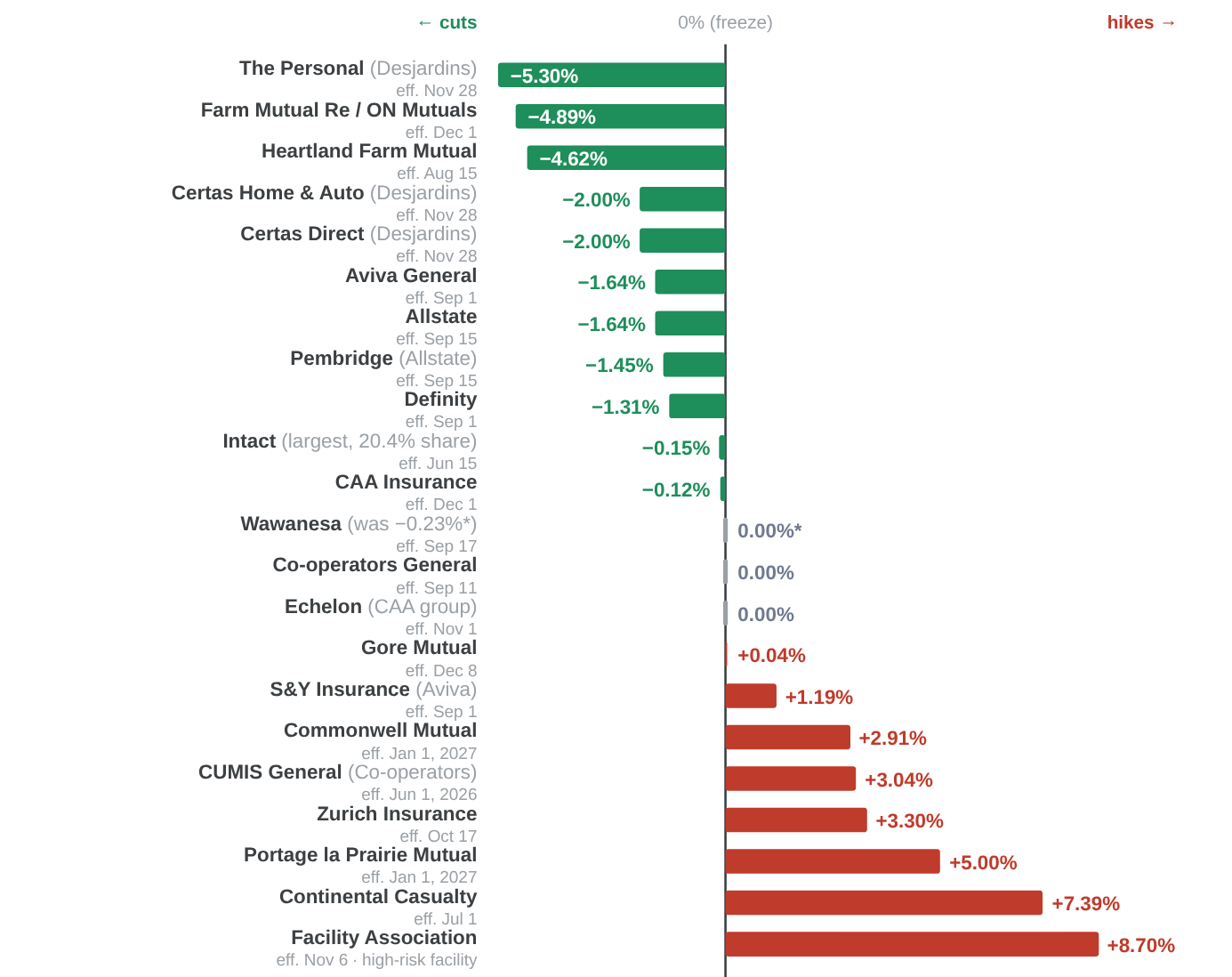
The market split is almost perfectly even. The InsuranceXpert tracker, which weights every filing by each insurer’s share of the Ontario market, finds that insurers writing 48.1% of the market have a net decrease approved over the trailing twelve months, while insurers writing 48% have a net increase. The rest froze rates, filed rule-only changes, or did not file. Your renewal outcome this fall depends mostly on which side of that line your insurer sits on.
Where the Ontario market sits, trailing 12 months to September 2026
Market share of insurers with net approved decreases versus net increases. Source: InsuranceXpert tracker computed from FSRA filings, fetched September 15, 2026.

What the cuts are worth against the last two years of increases
FSRA’s average premium figures put the dollar picture in focus. Between June 2024 and October 2025 the average Ontario premium rose $237 a year. Applied to that $2,164 average, the approved cuts return roughly $35 a year for Aviva and Allstate customers, about $100 for Heartland and Farm Mutual Re customers, and about $115 for customers of The Personal. The single largest cut in the window claws back less than half of one year’s average increase.
One year’s average increase versus the biggest approved refunds
Dollars per year at the $2,164 average Ontario premium (FSRA, October 2025). Refund values computed by DrivingTest from approved percentages.
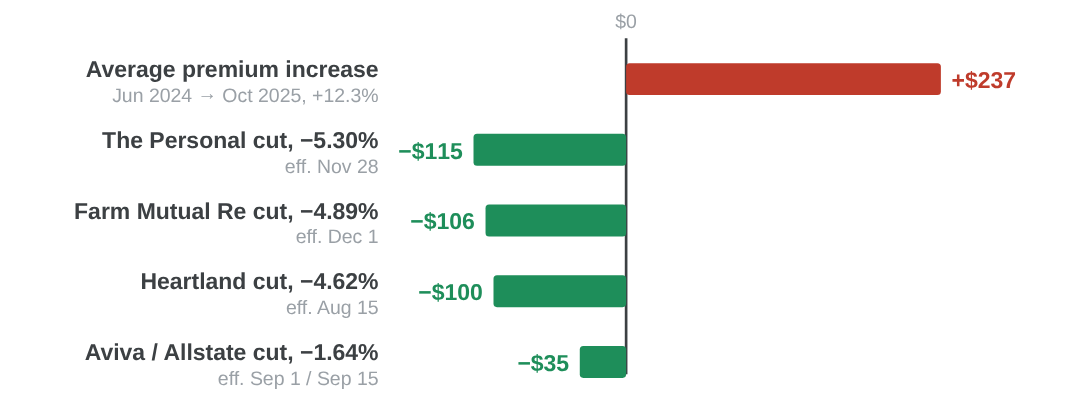
The broader price trend supports the same reading. Applied Systems’ Rating Index, which tracks more than 30 million anonymized broker quotes a quarter, found Ontario quoted premiums rose 11.8% year over year in the first quarter of 2026, down from 17.1% in the fourth quarter of 2025, and fell 0.2% from one quarter to the next. The cost pressure behind the spike is easing, and the regulator’s approvals are following it down. They have a long way to go: Statistics Canada reported in June that passenger-vehicle insurance premiums rose 23.9% between December 2019 and December 2025, against 21.0% for all-items inflation, driven by repair costs (up 22.6% over the same period) and insurers’ auto claim expenses, which grew from $13.3 billion in 2020 to $23.0 billion in 2024.
Is the July 1 accident-benefits reform behind the cuts?
The money.ca report raised the question without answering it, and the filings give no attribution either. On July 1, 2026, nine accident benefits that used to be automatic in every Ontario policy became optional, including income replacement, caregiver, housekeeping, death and funeral, and non-earner benefits. The theory is that insurers can now project smaller benefit payouts and pass some of that back in rates.
On timing, most of the cut filings were approved before the reform took effect: Aviva on April 22, Definity on April 28, Heartland on May 19, Allstate and Pembridge on June 17, and the three Desjardins filings on July 7. Insurers file forward-looking actuarial projections, so a reform that was legislated ahead of July 1 could have been priced in before it was live. But filings approved after July 1 point in both directions: Farm Mutual Re’s −4.89% (August 13) and CAA’s −0.12% (July 30) sit alongside Gore’s +0.04% (September 25), Commonwell’s +2.91% and Portage’s +5.00% (both September 4). FSRA has attributed no specific filing to the reform and assesses each on its own actuarial basis.
The Applied Index points to a simpler explanation. Claims-cost inflation turned down, and insurers that filed increases in 2023 and 2024 are now filing decreases.
Why your renewal might still go up
Being insured by a company on the cut list does not guarantee a lower bill, and FSRA says so on the database itself: the approved rate change is the expected average across all of an insurer’s renewals, and “an individual policy premium may go up, go down, or stay the same depending on personal factors such as the driver’s record, vehicle, location, and choice of coverage.”
The three ways a “rate cut” still produces a higher bill
Work out your own renewal in four questions
Will your fall renewal come down?
Follow the answers that match your situation. Ends in green, red or grey, with what to do in each case.
Check your own insurer in the regulator’s database (three minutes)
FSRA’s database is public and free.
Find the legal insurer name
Use the legal name printed on your policy documents or renewal letter. Brands and legal entities differ: Sonnet policies are underwritten by Definity, “The Personal” is the Personal Insurance Company, and Pembridge is Allstate’s brokerage channel.
Search the FSRA database
Go to autorateapprovals.fsrao.ca/search and type the insurer name. You get the approved rate change, the renewal effective date, and the approval date.
Match it against your renewal date
The change applies to renewals on or after the effective date. Insurers must send your renewal notice 30 to 60 days before expiry, so you have time to react.
Treat the approved average as the minimum to expect
If your letter shows an increase while your insurer’s filing shows a cut, ask your broker which rating factors moved. Individual movement inside the average is normal; a large divergence is worth a competing quote.
Your renewal letter now carries nine opt-out choices
Because of the July 1 reform, renewal notices now carry opt-out choices for nine accident benefits. Declining all of them saves roughly $75 to $100 a year, and income replacement accounts for nearly three-quarters of that saving, according to brokerage Surex. A self-employed contractor off work for a year after a serious crash could forgo up to $20,800 in income replacement benefits to save about $75 annually. Morgan Roberts, vice-president of Ratehub’s in-house brokerage RH Insurance: “The premium reduction from removing optional benefits is relatively small, roughly the cost of a couple of coffees each month, but the financial consequences of being underinsured after a major accident could be significant.” If you are self-employed, a gig worker, or the main earner in your household, read that section of the letter before you decide. Injury lawyer Nainesh Kotak’s test is to ask whether you could afford the lost income, caregiving and housekeeping costs after a serious collision.
A note for new drivers
If you passed your G2 or G this year, these averages barely apply to you. Approved cuts are spread across existing customers with claims histories, and your first quotes are built on licence class, age, vehicle and postal code with no insurance history at all. The practical moves are the same ones that apply at any renewal: get at least three quotes, ask about bundling and usage-based programs, and check the insurer’s filing in the FSRA database before you commit.
Filings keep landing through the winter
FSRA adds filings as it approves them, and January 1 renewals are still being set: Commonwell and Portage la Prairie have increases queued, and the market-weighted tracker for 2026 stands at −0.89%, the first net-negative year since 2021’s −0.37%. If claims-cost inflation keeps cooling at the pace of the last two quarters, more cuts are plausible through the winter renewal season. What the numbers do not support is reading this fall as the end of the premium climb. Ontario’s average bill is still $237 a year above where it sat in mid-2024, and the approved cuts return only a portion of that.
Sources
- FSRA Auto Rate Approvals database, retrieved October 2, 2026 (all filings, effective dates and approval dates in this article).
- money.ca via Yahoo Finance Canada, September 20, 2026: the nine original filings, FSRA average premium figures ($1,927 in June 2024, $2,164 in October 2025), and IBC commentary on the July 1 reform.
- FSRA rate-approvals explainer: disclaimer that approved changes are portfolio averages and individual premiums may rise or fall.
- Statistics Canada, Analysis in Brief, June 16, 2026: premiums +23.9% versus CPI +21.0% (December 2019 to December 2025), repair costs +22.6%, insurers’ auto claim expenses 2020–2025.
- CP24 / The Canadian Press, June 30, 2026: opt-out reform details, Surex savings estimates, Morgan Roberts and Nainesh Kotak quotes, 30–60 day renewal notice rule.
- Applied Systems Rating Index, Q1 2026 release: Ontario quoted premiums +11.8% year over year (from +17.1% in Q4 2025), −0.2% quarter over quarter.
- InsuranceXpert Ontario rate-approvals tracker, data fetched September 15, 2026: market shares (FSRA 2024), 2026 market-weighted change of −0.89%, and the 48.1% / 48% market split. (A third-party aggregation of FSRA’s own data; the primary filings above were verified directly.)
Refund values, the $237 increase and the 12.3% figure are DrivingTest computations from the cited FSRA figures. Approved percentages are averages across each insurer’s Ontario renewals; your premium may move differently.